From the Educator Handbook · Grades 6–12

Teach It Better

An integrated framework for relationships, learning, and accountability

Educators make decisions about behavior every day, often with limited time and incomplete information. A student may be confused, protecting status, avoiding a task, responding to stress, testing a boundary, seeking connection, or making a deliberate choice. More than one of those things may be true.

Different educational frameworks help adults notice different parts of the same moment. None gives us complete knowledge of a student, and none removes the need for professional judgment. Together, they can widen the questions we ask before deciding what to do.

The work begins before anything goes wrong.

An educator and a student working through a reflection sheet together at a table.
Prevent · Pause · Pivot · Repair · Return

Part I · The Strategy

Behavior is part of teaching. So are accountability, repair, and the return to learning.

A student refuses a reasonable direction. A correction becomes public. Frustration rises while the rest of the class watches. The expectation still matters, but pressing harder may make it less likely that the student can hear it. In that moment, the adult is teaching more than the rule. Tone, timing, audience, and the next available choice all shape what happens next.

Difficult moments rarely call for a speech. They call for judgment: whether to address the behavior now or later, whether to speak privately, whether the student is ready to reflect, and what support or accountability will help. A useful response protects safety and dignity without losing sight of the expectation.

A boundary may need to be held, and a consequence may be required. Even then, the student needs a workable next step and a way back to participation. When harm has occurred, the work also includes understanding the impact and taking part in repair.

No strategy works for every student or every situation. What helps depends on regulation, development, culture, access, the relationship already in the room, and what safety or school procedure requires.

We all bring background noise into the room. Notice it, find the moment again, and respond for growth—not for the win. — Hoy

The Method · Five Phases

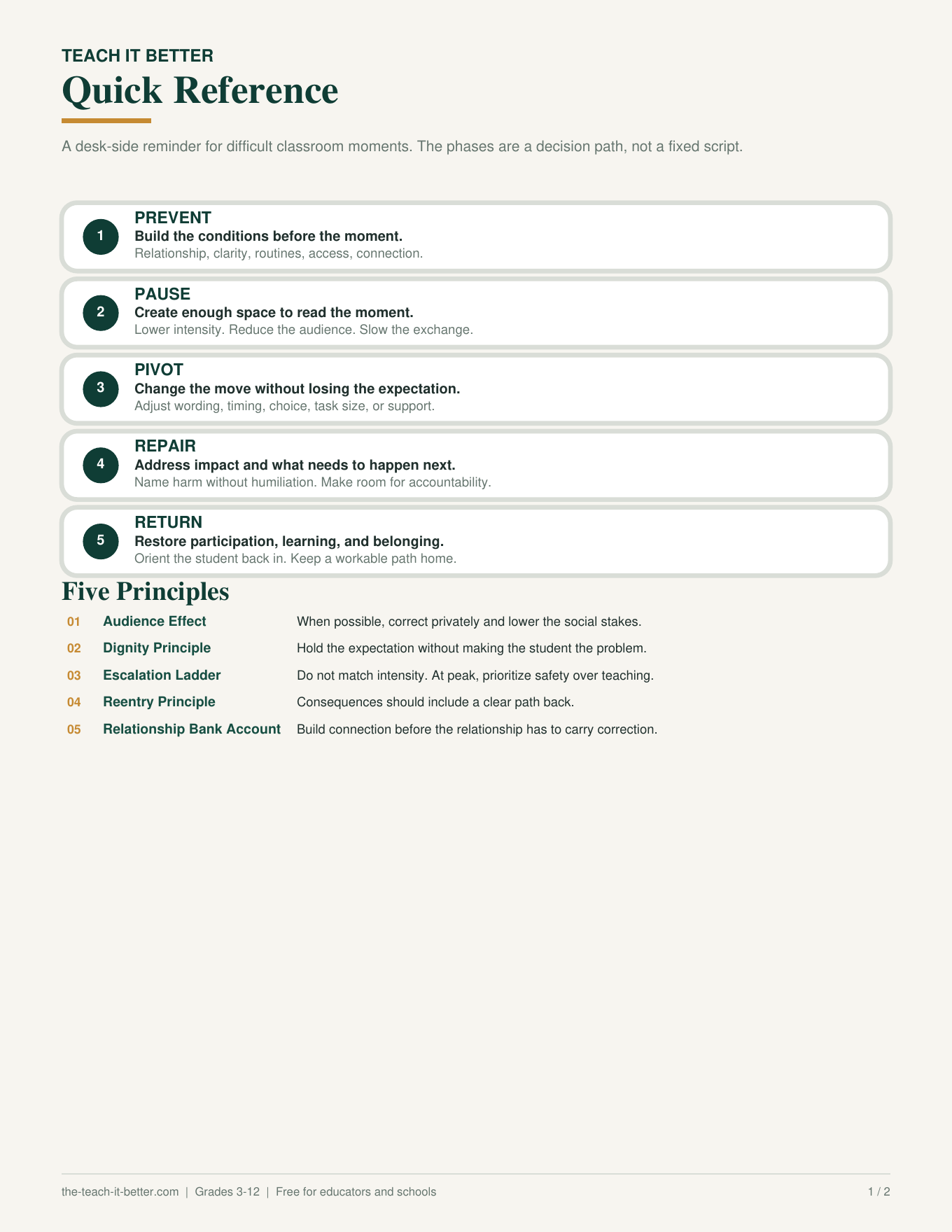
Prevent. Pause. Pivot. Repair. Return.

The five phases are Prevent, Pause, Pivot, Repair, and Return. They are not a fixed timeline. A moment may move quickly, stall, circle back, or require another adult. The phases help an educator decide what kind of response the moment can hold.

PHASE 01

Prevent

Prevention is not about predicting every difficult moment or controlling every variable in the room. Students are not equations to solve. Prevention removes avoidable barriers and strengthens the ordinary conditions that make participation more likely.

Look at what the classroom can actually shape: predictable routines, expectations that are taught and retaught, accessible directions, meaningful choices, supported transitions, and relationships built outside moments of correction. An expectation announced in September may need to be modeled again in February. A direction that sounds like refusal may first need to be checked for clarity, access, or understanding.

In practice

Before class, identify one transition or direction that regularly creates friction. Make the next step easier to see, hear, or begin. Then notice whether the change helps, who still needs support, and what should be adjusted.

Part I · The Five Principles

The Five Principles, at a glance

The phases help answer when and what: what the moment can hold and what kind of response is most useful now. The Five Principles shape how that response is carried out without losing dignity, relationship, accountability, or a way back. Neither is a script; the work still depends on the student, the setting, professional judgment, and school procedures.

1

The Audience Effect

The rule
Reduce the audience when the social setting is raising the stakes.
The move
When safe and feasible, use proximity, a quiet voice, or an agreed signal.
2

The Dignity Principle

The rule
Hold the expectation without unnecessarily damaging the relationship.
The move
Address the behavior while preserving the student’s dignity.
3

The Escalation Ladder

The rule
Step off the ladder; don’t climb it.
The move
Lower intensity, allow appropriate time and space, and follow protocol.
4

The Reentry Principle

The rule
Accountability with a way home.
The move
Offer a genuine welcome and clear next step, adapted to the situation.
5

The Relationship Bank Account

The rule
Build the relationship before you need it.
The move
Build authentic connection and examine who receives acknowledgment and correction.

See each principle in full

Practical Language

Instead of this, try this

Try these as starting points, not formulas. Different words will work for different people, relationships, cultures, communication needs, and situations. Educators and students should rewrite them into language they can say honestly.

Principle 01 · The Audience Effect

Say

[walk over, quiet, beside them] “Phone in the bin for ten minutes, then it’s yours. Thanks.”

Principle 02 · The Dignity Principle

Say

“You’re better than this moment. Let’s fix it. I’ll help.”

Principle 03 · The Escalation Ladder

Say

“I’m going to give you a minute. I’ll be right back.” [step away, lower voice]

Principle 04 · The Reentry Principle

Say

“Glad you’re back. Clean slate. Here’s where we are, jump in right here.”

Principle 05 · The Relationship Bank Account

Say

[at the door, by name] “Morning, Sam. Good to see you. Loved your point yesterday.”

Part III · The Conversation Case

Say

Walk me through what was happening for you. I believe you didn’t mean it that way, and it landed that way. What would make this closer to right?

Find your move →

Diagram: overlapping petals labeled PBIS/MTSS, Restorative Practice, De-escalation, Transferable Skills and SEL Traditions, Experiential and Service Learning, and Culturally Responsive and Equity Centered — all circling a center labeled The Student and the Moment.

Part II · Connecting Frameworks

The shared center

Most schools already use more than one approach to behavior, relationships, and school climate. The crosswalk translates points of connection while preserving the history, purpose, language, and practice expectations of each approach.

Trauma-informed practice

Contributes attention to safety, trust, regulation, and the conditions needed for learning.

Restorative practice

Contributes attention to belonging, impact, accountability, repair, and return.

PBIS

Contributes structure: expectations taught explicitly, prevention, acknowledgment, and graduated support.

At the shared center, Prevent, Pause, Pivot, Repair, and Return organize the adult response across the moment. The Five Principles keep attention on audience, dignity, escalation, reentry, and relationship. The school’s existing approaches remain the methods behind the shared language.

The Library

The Library

Part II

Connecting Frameworks

Teach It Better brings these contributions into shared language for everyday relationships and difficult school moments. It begins with genuine interest, prevention, and positive community. It asks adults to notice their own role in an interaction, protect dignity while maintaining expectations, match reflection and repair to readiness, and preserve a credible path back to learning and belonging.

The framework does not replace the practices, professional learning, judgment, or school-based protocols behind the work. It gives educators a common way to draw from them when deciding what the moment can hold and what might make the next constructive step more possible.

PreventPausePivotRepairReturn

Watch

Watch a move in two minutes.

New moves regularly — the reflex, the better move, and why it works.

Get the guides

The guides are free.

Email us and we’ll send the Handbook, the Teacher and Facilitator guides, and the field guides your way. Copy freely within your school. Keep the Teach It Better attribution line when sharing beyond your building. If you improve one, send the better version back.